


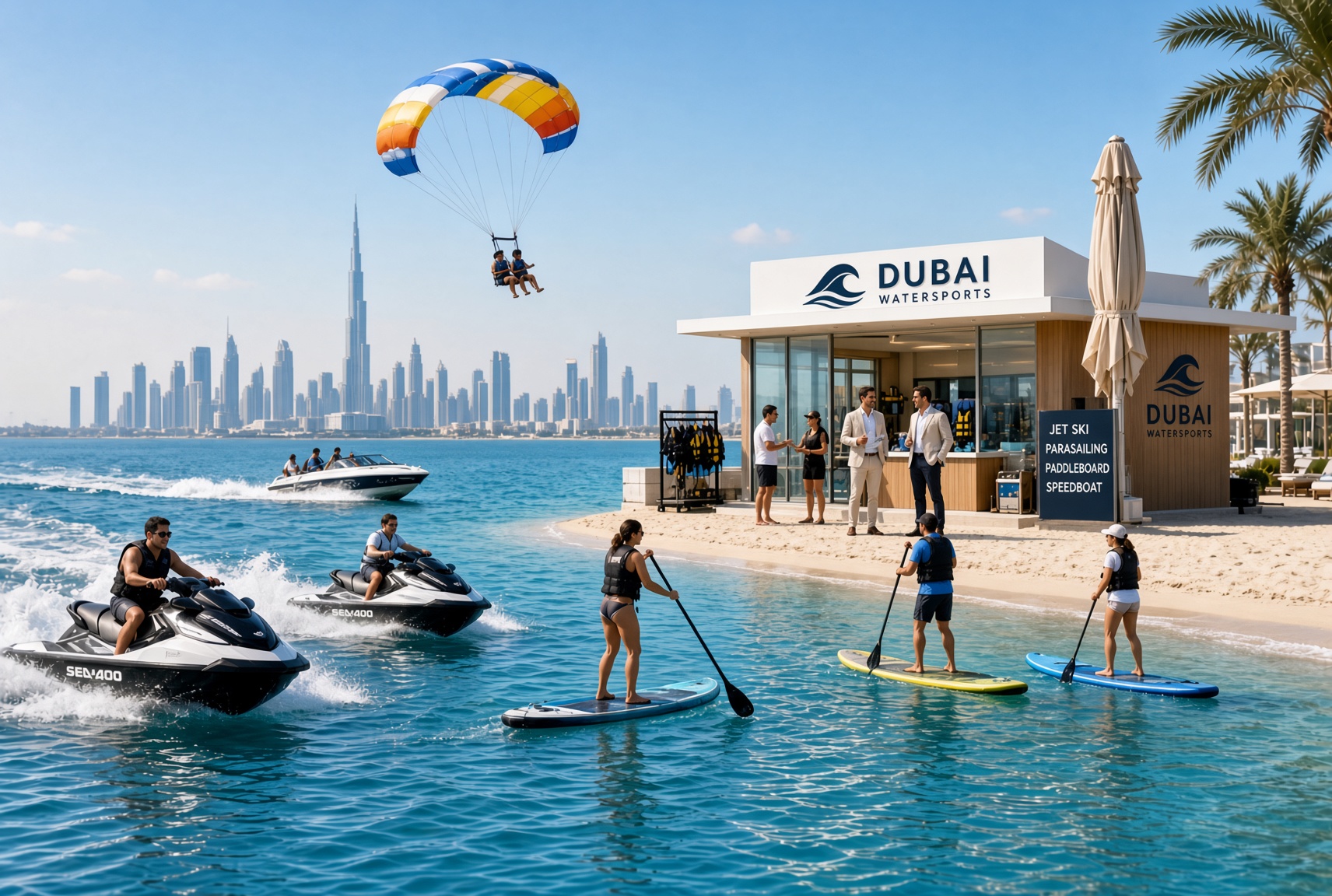


Ask most owners of a watersports business what they're selling and they'll walk you to the water and point at the fleet. Six jet skis, two boats, the parasail rig, the flyboard, the trailers, the workshop.
That's the inventory. It isn't the business.
Anyone with capital can buy jet skis. They're available new, they're available used, and a buyer with AED 400,000 can have a comparable fleet delivered inside a month. What that buyer cannot do, at any price, is walk onto your stretch of beach and start operating.
That permission is the business. Everything else is equipment.
The test that settles it
Here's a question worth sitting with. If your entire fleet were destroyed tomorrow but your operating rights remained intact, how long before you were trading again?
Weeks. You'd replace the equipment, take the insurance money or the finance, and be back on the water.
Now reverse it. Your fleet is untouched, in perfect condition, but you lose the right to operate from that location. How long before you're trading again?
Most operators can't answer that, because the honest answer is that they might not be. They'd be starting from zero — finding a location, seeking permissions that may not be available, competing for a spot someone else already holds.
That asymmetry is your valuation. The thing that takes weeks to replace is worth less than the thing that might never be replaceable.
Why access is genuinely scarce
Coastline is finite. Dubai's usable beachfront is a fixed length, most of it already allocated to hotels, beach clubs, public beaches under municipal control, and the operators already working it.
That scarcity is structural, not cyclical. It doesn't ease when the market softens. Every new hotel that opens absorbs another stretch. Every beach club concession removes another. The supply of places where a watersports operator can legally launch does not grow to meet demand.
Add to that the layers of permission any marine activity operator needs, which in the UAE typically involve:
- A tourism or marine activity trade licence for the commercial activity itself
- Vessel registration for each craft with the relevant maritime authority
- Operator and skipper certification for the people driving them
- Permission covering the specific location you launch from and the water you operate in
- Insurance at the levels the authorities and the site owner require
Each of those has its own issuing body, its own conditions and its own renewal cycle. A buyer isn't just acquiring a business; they're acquiring a position inside a permission structure that took years to assemble.
Access comes in different forms, and they're not equally valuable
This is where sellers and buyers most often talk past each other. "We operate from the beach" can mean several very different things.
A municipal permit for a public beach location. Issued by the authority, tied to conditions, usually renewable, and usually tied to the operator rather than freely tradeable.
A concession or agreement with a hotel or resort. You operate the watersports for their guests, or from their beach. This can be the most lucrative arrangement and the most fragile, because it depends on a commercial relationship that may have a termination clause, a change-of-control clause, or an expiry that isn't far away.
A berth or slot at a marina. More formal, often more transferable, but with its own waiting lists and costs.
A sub-arrangement with another operator. You work from someone else's permitted area. Cheapest to start, weakest to sell, because what you hold is somebody else's permission.
A buyer needs to know which of these they're being offered, in writing, before anything else in the deal matters. Two watersports businesses with identical fleets and identical revenue can be worth very different amounts purely on this.
The uncomfortable part: it may not transfer
Here is what sellers least want to hear and buyers most need to ask.
Operating permissions are frequently tied to the specific licensed entity, and sometimes to a named individual. They do not automatically follow a sale. Depending on the arrangement, a transfer may require:
- The issuing authority's approval of the new owner
- The hotel's or landowner's consent, at their discretion
- Fresh applications rather than a transfer, with no guarantee of the same terms
- Requalification of the operator against current requirements, which may be stricter than when the permission was first granted
This is precisely why a share sale and an asset sale produce such different outcomes in this sector. Buy the company and the permissions may continue with it. Buy the assets and you may be buying jet skis with nowhere to launch them.
If you're selling, resolve this before you go to market. If you're buying, get it in writing from the issuing party — not from the seller — before you commit to anything.
What this means for the price
Once you accept that access is the asset, valuation stops being an equipment exercise.
Equipment sets the floor, not the price. Used marine equipment in a hot, salt-water environment depreciates hard. A three-year-old jet ski that cost AED 80,000 does not resell at AED 80,000. Any valuation that adds up the fleet at anything near purchase cost is a valuation that will not survive a buyer's inspection.
Secured, transferable access carries a real premium. A business with a documented, multi-year, transferable position on a good beach is worth substantially more than an identical business operating on an informal or short arrangement. That is not sentiment; it's the buyer pricing the risk of losing the thing that makes the business exist.
Tenure matters as much as terms. Six months of remaining access with no renewal commitment is not the same asset as four years with a clear extension path. Buyers price the runway they're getting.
Seasonality has to be read honestly against it. A watersports business earns most of its money in a compressed part of the year. If access expires just before the peak season, the buyer is paying for a business that may not reach its next earning window. That is a pricing issue, and a serious one.
If you're selling: what to prepare
- The written basis of your operating position — permit, agreement or concession, with the actual document, not a description of it
- The expiry date, and any renewal history showing it has been renewed before
- Confirmation from the issuing party on whether it transfers, and on what conditions
- Vessel registrations for every craft, with the registered owner named
- Operator and skipper certifications, and whether they're tied to individuals who are leaving
- Insurance certificates and the coverage levels required by the site
- Any change-of-control clause in a hotel or landowner agreement
- Three years of revenue split by month, so the seasonality is visible rather than hidden
Sellers resist assembling this because it feels like handing a buyer reasons to discount. The opposite is true. Ambiguity is what gets discounted. A documented, transferable position is the single strongest argument you have for your asking price.
If you're buying: what to establish first
Before you look at a single financial statement, establish where the business is allowed to operate, on what basis, for how long, and whether that survives the sale. If the answer is unclear, the financials are describing a business you may not be able to run.
Everything else — fleet condition, staffing, bookings, OTA dependency — matters. But it matters second.
Frequently Asked Questions
What is the most valuable asset in a watersports business? In almost every case, the right to operate from the location, rather than the equipment. Fleets are replaceable within weeks. Operating positions on a good beach may not be replaceable at all.
Does a beach operating permit transfer when the business is sold? Not automatically. Depending on the arrangement it may require the issuing authority's approval, the landowner's consent, or a fresh application. This should be confirmed in writing with the issuing party before completion.
How should a watersports business in Dubai be valued? Equipment sets a floor, but the value sits in earnings supported by secured, transferable access. A business with long, documented access is worth materially more than one with the same fleet and an informal position.
Why does seasonality matter so much in this sector? Revenue is concentrated into part of the year, so annual figures can mislead if read as an even run rate. A buyer should see revenue split by month across several years, and should check that access runs safely past the next peak season.
What should I ask a seller first? Where you are permitted to operate, on what document, until when, and whether it transfers. If those four questions don't have clear written answers, nothing else in the deal is settled.
Thinking about selling a watersports or activity business?
BFS Commercial Brokers works with owners across Dubai and the wider UAE, including tourism and activity operators. If you're considering a sale, we'll tell you honestly what your position is worth and what a buyer will ask for before they ask it.
Contact us at info@businessesforsale.ae or via businessesforsale.ae.
This article is general information, not legal or regulatory advice. Permit and licensing requirements for marine and beach activities in the UAE vary by emirate, location and activity, and change over time. Confirm your specific position with the relevant authorities and a qualified advisor before buying or selling.









Sharing Is Caring!