




Every week we speak to owners in Dubai who want out of a shop, a salon or a café, and almost all of them start in the same place: what is it worth?
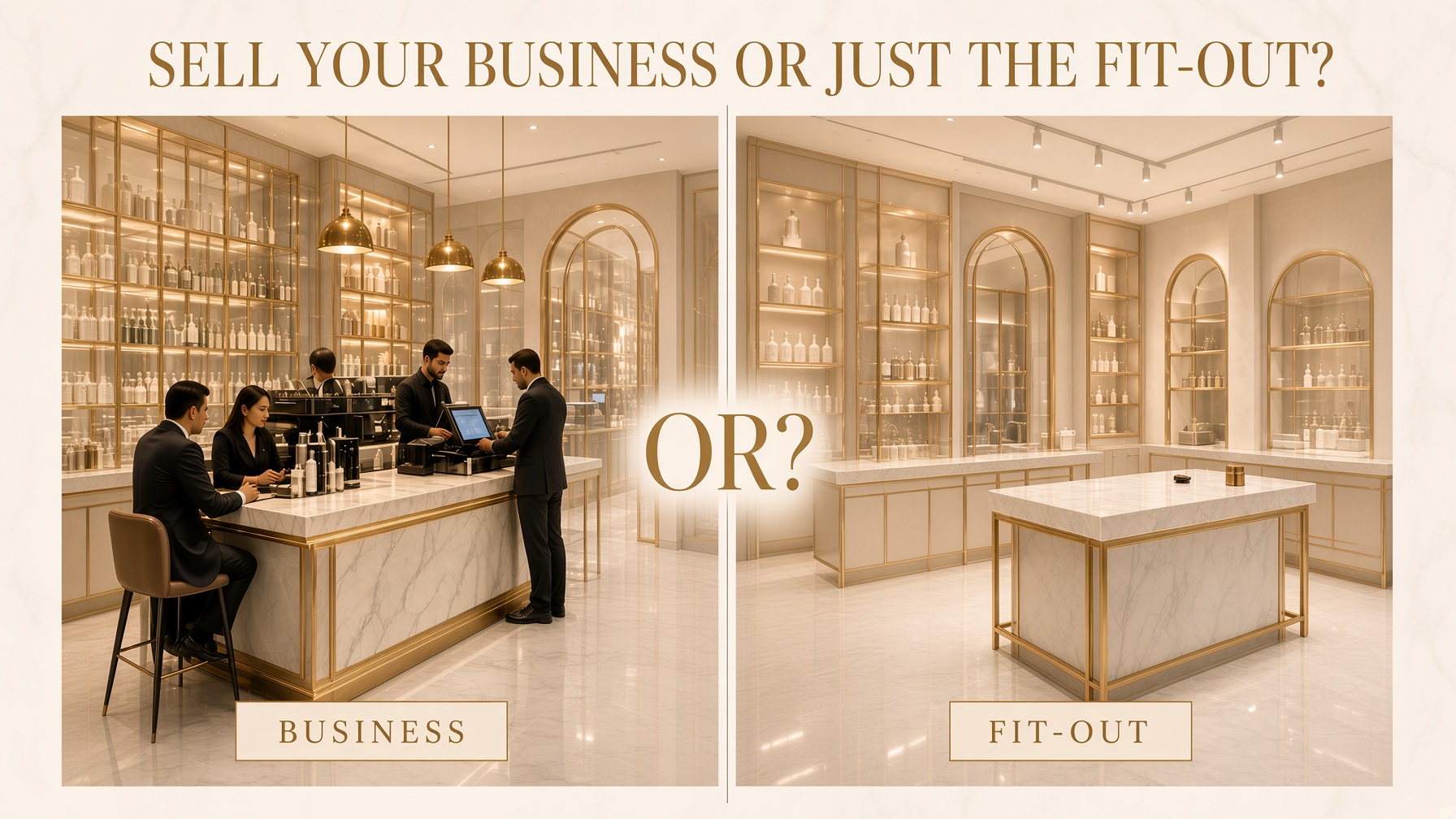
The honest answer is that there is no single number, because there are two completely different things you might be selling. You can sell the business — trading, staffing, customers and all. Or you can sell the fit-out — the walls, the equipment and the right to walk into a finished unit.
They attract different buyers, they price on different logic, and they sell at very different speeds. Choosing the wrong one is the most common reason a listing sits for months with no offers.
The two ways to sell
Selling as a going concern means the buyer takes over a live, working business. The trade licence transfers, the lease transfers, the staff stay, and the customers keep coming through the door on Monday morning as if nothing happened.
Selling the fit-out means the buyer takes the premises and everything physical inside it. They bring their own brand, their own licence in some cases, and their own idea of what the space should be. What they are buying is time — no shell-and-core wait, no six weeks of contractor work, no municipality approvals from scratch.
How each one is priced
This is where owners lose money, usually by assuming the first route is available when the second is what the market will actually pay for.
A going concern is priced on what it earns.
A buyer looks at net profit and applies a multiple. The multiple depends on the sector, how stable the profit is, whether it is verified, and how much of it depends on the owner personally being there. Strong, provable earnings command a real multiple. Weak or unproven earnings command almost nothing, because a buyer is not paying for a number they cannot check.
A fit-out is priced against replacement cost.
The buyer asks what it would cost them to build the same space from empty, then expects to pay less than that. How much less depends on how usable your fit-out is to them. A generic café layout transfers well. A heavily branded interior with your name tiled into the floor does not.
The gap between the two is the whole game. A shop with AED 500,000 of documented build cost and no profit might sell around asset value. The same shop with clean, provable earnings can be worth multiples of that.
When you should sell the fit-out only
Be honest with yourself. The fit-out route is the right one when:
- The business is loss-making, or the profit only exists on paper
- Your accounts do not support the number you have in your head
- Your trade licence activity does not suit most buyers, or is not transferable
- The staff will not stay, or the business runs entirely on you personally
- The lease has under a year to run and renewal is not confirmed
- The brand has no following worth transferring
None of this means the sale is a failure. Fit-out sales close quickly, because the buyer has far less to check. There is no due diligence on three years of accounts, no argument about add-backs, no long negotiation on a multiple. A buyer who wants your location and your kitchen can decide in a week.
When you should sell as a going concern
Hold out for the full business sale when:
- You have verifiable profit — accounts, VAT returns, POS history that all agree
- The lease has real time left, and the landlord will approve a transfer
- The trade licence transfers with the business
- Trained staff will stay through and after the handover
- You have something a buyer cannot rebuild: a customer database, a loyalty programme, a booked-out schedule, an online channel
The last point is worth dwelling on. Courts and coffee machines can be bought. A customer base that already turns up cannot. If you have one, that is the asset you are really selling.
The Dubai-specific things that decide it for you
Wherever you land, four things in the UAE will shape the answer more than the business itself.
- The lease. Your Ejari end date matters more than almost anything. A buyer paying for future earnings needs to know they will still be in the unit to collect them. If your tenancy expires soon and renewal is only a verbal expectation, buyers will price you as a fit-out sale no matter what you call the listing.
- The landlord. Malls and larger developers approve who takes over a unit, and some charge a transfer fee. Get the position in writing before you market. A deal that collapses at landlord stage costs you months.
- The licence. If the buyer's intended activity does not match the licence, it does not transfer cleanly. Check this early rather than discovering it at transfer.
- Liabilities. Unpaid supplier invoices, VAT arrears, end-of-service dues and staff visa costs all surface in due diligence. They do not always kill a deal, but they always come off the price when they appear late.
How to decide, in one question
Ask yourself this: if a buyer sat down tomorrow with your accountant and your POS, would the numbers back up what you are asking?
If yes, sell the business, and price it on earnings.
If no, sell the fit-out honestly and price it against build cost. Buyers respect a straight asset sale. What they do not forgive is a business marketed as profitable that falls apart the moment they look at the statements — and in a market this small, that reputation follows a seller.
Get a view before you commit
Most owners only sell a business once. We see it every week, across salons, cafés, clinics, gyms and retail units, and we can usually tell within one conversation which of the two routes will actually get you paid.
Send us the basics — sector, location, rent, lease end date and whatever numbers you have — and we will tell you straight which way to go and what you can realistically expect.
FAQ .
Is it faster to sell a business or just the fit-out?
Fit-out sales usually close faster, because there is much less for the buyer to verify. A going-concern sale takes longer but can be worth considerably more if the earnings are provable.
Can I sell the fit-out if I do not own the premises?
Yes. What you are selling is the improvements and equipment, together with the transfer of the lease, which is why the landlord's approval matters so much.
Does the trade licence transfer with the business?
It can, if the activity suits the buyer and the authority permits the change of ownership. Confirm this before marketing, not after an offer is agreed.
How do I prove my profit to a buyer?
Accounts, VAT returns, POS history and bank statements that agree with each other. If those four tell different stories, buyers will price on the lowest one.
What if my lease expires in a few months?
Get written confirmation of renewal from the landlord before you list. Without it, most buyers will treat the sale as a fit-out purchase.
.jpg)







Sharing Is Caring!